

AI-Driven Audience Segmentation
Use case
Teams across subscriptions, advertising, and editorial needed an easier way to define and activate audience segments. The existing approach relied on a licensed downstream segmentation platform that was powerful but complex to use, making it difficult for stakeholders to discover whether a similar segment already existed, and slowing down iteration.
The goal was to simplify segment creation without replacing the downstream activation system: stakeholders should be able to express intent clearly, validate the audience shape before saving, and operationalize segments quickly for advertising and on-site messaging.
Approach
We designed an internal, AI-assisted segmentation workflow that reduced complexity for stakeholders while retaining the downstream activation system. The core idea was to move segment discovery and definition into a simple, purpose-built user experience that translated stakeholder intent into reliable, governed logic.
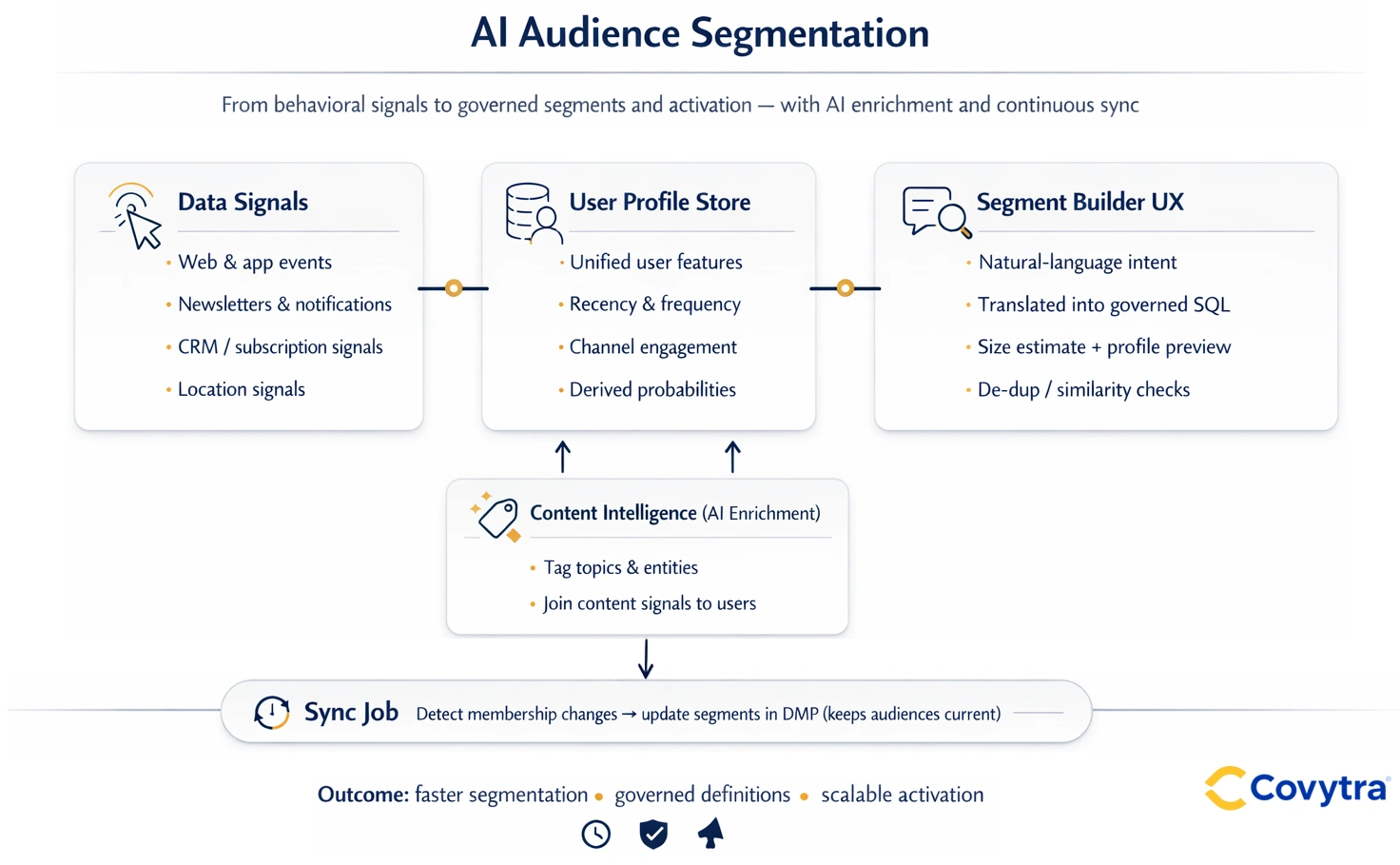
At the data layer, we built a user-level behavioral profile store based on web analytics events and engagement signals. In parallel, we enriched behavioral signals by classifying content with AI—tagging articles and assets by topics and entities such as people and places—so that user behavior could be understood in a more meaningful, contextual way.
To make segmentation accessible, stakeholders could describe the audience they were looking for in natural language. The system translated that intent into a SQL query, returned estimated audience size, and provided a preview of representative user profiles, enabling quick iteration before a segment was saved.
Solution
The delivered solution was a dedicated segmentation application running independently from the downstream activation system, backed by a structured SQL user profile table with a wide set of features. These features captured behavioral engagement patterns as well as lifecycle and channel signals such as newsletter relationships, notification engagement, recency, frequency, and other visit patterns.
Where useful for activation, the profile layer also included derived demographic probabilities based on observed behavioral patterns and available location signals. This enabled more flexible targeting use cases without relying on stakeholders to stitch together signals manually in multiple systems.
Once a segment definition was confirmed, the application pushed the resulting segment into the downstream activation system. A synchronization process continuously checked whether a segment’s membership had changed and updated the segment as needed, ensuring the activation audience remained current without requiring repeated manual rebuilds.
Results
Stakeholders gained a significantly simpler and faster way to create segments, improving adoption and reducing time spent navigating complex workflows. The preview-and-estimate flow reduced trial-and-error and helped prevent duplicate or near-duplicate segments by making similarity and audience shape visible early.
Operationally, the approach reduced dependency on specialized technical users for day-to-day segmentation work. Teams could iterate on targeting logic more quickly, while the downstream activation system continued to serve as the activation hub for ad serving and on-site subscription and messaging experiences.
The outcome was a more scalable audience activation capability: richer segments informed by behavioral and content intelligence, a lower operational burden, and a workflow that aligned stakeholder intent with governed, reproducible segment definitions.
Let's talk
Together we will find the right approach for your needs.