

Automated AI Traffic Bulletins
Use case
A national news broadcaster needed to provide frequent, country-wide traffic and train updates in short 45-60 second slots for radio and TV. These updates were previously purchased from an external provider, were difficult to monetize, and required manual production effort-despite being time-critical and prone to errors. The team wanted a scalable, lower-cost, AI-driven solution that could showcase advanced AI capabilities and unlock new sponsorship opportunities within the traffic segments.
Approach
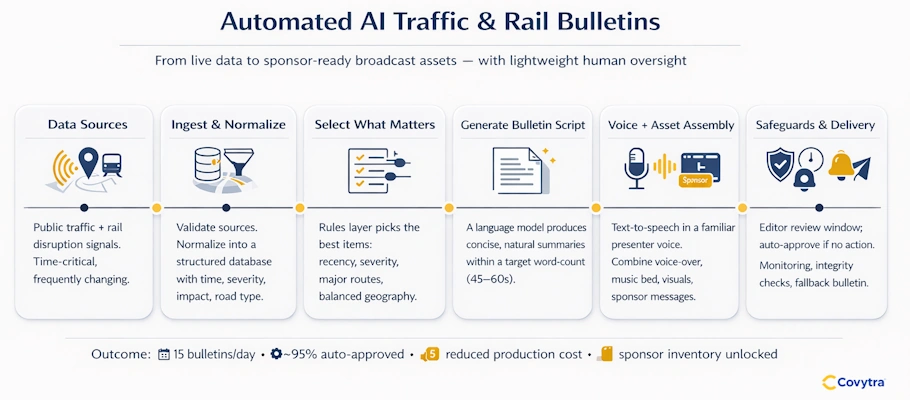
The team designed an end-to-end internal workflow that automated content generation while keeping humans in the loop where it mattered. Publicly available, programmatically accessible traffic and rail sources were identified, legally validated for use, and ingested into a structured SQL database, including timestamps, severity, impact, and road types. On top of this, a rules layer (recency, severity, impact, major routes, and a balanced geographic mix) algorithmically selected the most relevant items to fit a 45-second national bulletin.
For language generation, the selected items were sent to a language model through an API, with prompts tuned for concise, natural summaries within a defined word-count range that mapped to the target audio length. For delivery in a familiar voice, presenters recorded several minutes of training audio to create cloned voice models; the system then performed text-to-speech via API calls. Backend logic assembled the final asset by combining voice-over, music bed, a visual traffic template for TV, and pre-/post-sponsorship messages into a single MP3/video output.
Because the content was time-critical yet subject to AI errors, a lightweight human-in-the-loop review was implemented. Each newly generated bulletin was sent to a group of editors by email, including the script, word count, and a preview link. Editors could approve or adjust the text; the system would then regenerate and automatically replace the edited file. If no action was taken within the approval window, the system auto-approved to ensure a file was always ready for broadcast.
Solution
The final solution was a fully internal, automated AI application that produced hourly (and sometimes half-hourly) traffic and train bulletins between 06:00 and 18:00 on weekdays. It continuously harvested and normalized traffic data, applied selection rules, generated summaries with a cost-efficient but modern language model, and converted them into audio using cloned presenter voices. The pipeline then stitched audio, graphics templates, and music into a broadcast-ready asset stored in the backend and delivered to an external playout provider, including checksum and file-size checks to reduce the risk of corrupt files.
Operational safeguards were added to handle common failure modes. This included generating a nightly generic "fallback" traffic bulletin focused on planned events and near-future disruptions, which could be used if real-time generation failed. In addition, technical checks (for example file integrity issues during transmission) and manual interventions on the playout side allowed problematic files to be blocked if an issue was detected late. The solution also included an editor approval process and logging that distinguished between machine and human approvals, enabling monitoring of how often human oversight was actually required over time.
Results
The broadcaster replaced a paid external traffic-news provider with an internal AI-driven service, significantly reducing recurring content costs while keeping-and in many cases improving-perceived quality. A shorter creation cycle also enabled more near real-time coverage. The new setup provided full control over the final audio/video output, enabling integrated sponsorship messages before and after the bulletin and turning traffic updates into monetizable inventory with predictable schedules.
From a performance perspective, the system reliably produced updates judged to be "human-equivalent" in quality for this use case in the vast majority of cases (around 99% according to internal assessment), while being far more scalable and significantly faster than manual production. Initial issues such as corrupt files and occasional hallucinated locations were identified and mitigated through additional checks, rules, and prompt refinements, with manual approvals decreasing over time as confidence grew. Internally, the project demonstrated that AI could safely handle a live, time-critical workflow, helped broaden interest in further AI applications, and clarified where regulation, risk, and complexity would make similar approaches harder for more sensitive news formats.
Let's talk
Together we will find the right approach for your needs.